 跨境独立站开店
How to Start an Online Wine Sales Business: Sourcing, Permits, and Important Points
This guide will show you how to start an online wine sales business. We'll cover sourcing methods, necessary permits, and important points to consider for wine e-commerce, helping you with your business plan and marketing preparations.

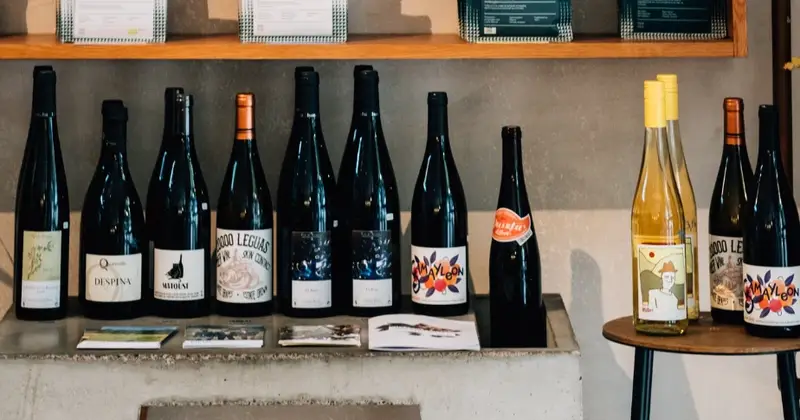
This article summarizes how to start an online wine sales business.
If you love wine and want to start a business that leverages your knowledge and passion for it, why not try selling wine online?
Since wine is an alcoholic beverage, you will need to prepare for opening a wine shop in addition to the general preparations required for opening an online store, such as obtaining a wine sales license. Also, the rules regarding procurement and sales differ between domestic and imported wines.
This article provides a clear explanation of the steps involved in starting an online wine sales business, including things to check when sourcing wine, necessary licenses and precautions, and key points for successful sales.
6 Steps to Starting an Online Wine Sales Business
- Decide which wines to sell and the shop's policy.
- Secure a wine supplier.
- I will apply for a mail-order alcohol retail license.
- Create an e-commerce site
- Prepare packaging and shipping systems.
- Start attracting customers
1. Decide which wines to sell and the shop's policy.
First, decide what kind of wine you will sell and to whom. For example, consider the direction of your products, such as focusing on domestic wines, specializing in natural wines, or stocking wines from specific regions or grape varieties. At the same time, clarify your main customer base, such as wine beginners, enthusiasts, or people looking for gifts. Clearly defining the wines you will handle, your target customer base, and the characteristics of your shop will form the foundation for building your brand.
Based on this, conduct product research and competitor analysis to identify products and price ranges in demand, as well as the product ranges and services offered by other shops. Develop a pricing strategy that reflects your store's unique characteristics and create a business plan that includes sales and profit targets.
2. Secure a supplier for wine.
Before obtaining a license to sell wine, you must secure a supplier.
Since suppliers must be identified when applying for a license, it is not possible to obtain the license first and then decide on suppliers later.
To find suppliers, you can attend wine exhibitions, tastings, and industry trade shows, and consult with domestic wineries, liquor wholesalers, and importers. Alternatively, you can research stores and e-commerce sites that sell the wines you want to carry, and then check the product labels to identify the manufacturer or importer before contacting them.
There are mainly the following options for sourcing wine:
- Domestic wineries: If you can obtain information directly from the producer about the characteristics of the product, manufacturing methods, and origin, you can use this information to create product pages and feature articles. Check whether the product falls under the category of domestic alcoholic beverages that can be sold with a mail-order alcoholic beverage retail license.
- Domestic liquor wholesalers and importers: By using businesses that handle products from multiple wineries and regions, you may be able to purchase multiple products in bulk.
- Overseas wineries: By building direct relationships with overseas producers, it may be possible to handle products that have limited distribution within Japan. On the other hand, you will need to handle tasks such as negotiating terms of trade, placing orders, international money transfers, and arranging transportation yourself.
- Overseas sales companies and exporters: You may be able to select multiple overseas products together. Check the products offered, prices, order quantities, and shipping conditions.
3. Apply for a mail-order alcohol retail license.
Once you've decided on the wines you'll sell, your suppliers, and your sales location, you'll apply for a mail-order liquor retail license at the tax office that has jurisdiction over the location of your sales location. The application requires documents such as floor plans of the sales location, projected income and expenses, a financial plan, and information about your suppliers and sales methods.
The standard processing time for license applications is generally about two months from the date of application. Please apply and proceed with the process well in advance.
4. Create an e-commerce website.
You can set up your shop's design, product categories, payment methods, inventory management, and shipping methods.
Because there are so many types of wine, it's helpful to be able to search for products by color, origin, grape variety, price range, taste, and occasion. In addition to basic information such as volume and alcohol content, product pages should include information on aroma, acidity, sweetness, tannins, body, and food pairings.
In addition, we will implement age verification to prevent sales to those under 20 years old, as well as necessary markings such as the liquor sales manager's sign.
5. Establish a packaging and shipping system.
Wine bottles are fragile and their quality can be affected by temperature changes. Prepare shipping boxes and cushioning materials that can secure the bottles, and consider using refrigerated shipping during the summer months.
Packaging not only ensures the safe delivery of your product, but also enhances the customer's unboxing experience. Including a wine description card, storage and serving instructions, and a message from the shop can provide more detailed information about the product and brand.
If you plan to sell gifts, you should also decide on services such as wrapping, gift tags, and message cards. Furthermore, you should have a policy in place for replacements and refunds in case of damage or leakage.
6. Start attracting customers.
Creating articles that answer customer questions, such as wine pairings with food or how to choose wine for beginners, can help people discover your products through searches. On social media, share not only product photos but also food pairings and stories about the producers.
Licenses and procedures required for online wine sales
To start selling wine online, you need to obtain a mail-order liquor retail license for each sales location and appoint a liquor sales manager. This article explains the licenses and procedures required when selling to a wide area, such as nationwide.
Mail-order alcoholic beverage retail license
To sell wine online to consumers in a wide area encompassing two or more prefectures, a mail-order liquor retail license is required. This license allows you to advertise products via the internet or catalogs, and to sell alcoholic beverages by taking orders online.
A mail-order liquor retail license is obtained for each "sales location" where liquor is sold. The application should be submitted to the tax office that has jurisdiction over the location of the sales location.
A general liquor retail license is required to sell wine in a physical store. A general liquor retail license allows for mail-order sales targeting consumers within the same prefecture as the store, but not for mail-order sales targeting a wider area of two or more prefectures. If a physical store that already holds a general liquor retail license wants to start nationwide online sales from the same store, it will need to go through a procedure to relax the mail-order sales conditions attached to its existing license.
Requirements for obtaining a license for mail-order alcoholic beverage retail.
To obtain a mail-order alcohol retail license, you must submit an application and supporting documents, and undergo a review based primarily on the following four requirements.
- Personal requirements: Must not have had their liquor sales license revoked in the past, and must not have a history of certain violations related to the Liquor Tax Law, etc.
- Location requirement: The sales area must be clearly separated from other liquor sales areas, restaurants, etc., and be a place where sales operations can be properly managed.
- Basic business requirements: No outstanding tax payments, sufficient funds to continue the business, management capabilities, experience and knowledge in alcohol sales, etc.
- Supply and demand adjustment requirements: The alcoholic beverages sold, suppliers, and sales methods must be those permitted under the mail-order alcoholic beverage retail license.
Since preparing and reviewing documents takes time, it's best to consult with your local tax office and allow ample time for the process.
Wine that can be sold with a mail-order alcoholic beverage retail license
In principle, only domestically produced wines that can be sold are those from manufacturers whose taxable shipment volume for each type of alcoholic beverage in the previous fiscal year was less than 3,000 kiloliters.
This standard applies not only to the wine you wish to sell, but to all types of alcoholic beverages handled by the manufacturer. When purchasing domestic wine, be sure to check with the manufacturer or supplier to see if it is a product that can be sold under a mail-order alcoholic beverage retail license. When applying for the license, you will need to submit a certificate issued by the manufacturer regarding the taxable quantity of alcoholic beverages shipped.
Imported wines are not subject to the same quantity restriction of less than 3,000 kiloliters that applies to domestic alcoholic beverages. Imported wines purchased from domestic alcohol wholesalers and importers can be sold within the scope of a mail-order alcoholic beverage retail license.
However, if you import wine directly from overseas and sell it on your e-commerce site, you will need to go through procedures such as filing a food import notification, customs clearance, and creating Japanese labels, in addition to obtaining a mail-order alcoholic beverage retail license.
Appointment of a liquor sales manager
When starting online wine sales, you must appoint a liquor sales manager for each sales location. The liquor sales manager is responsible for advising businesses and providing guidance to employees to ensure that sales are conducted in accordance with the law, including preventing sales to minors under 20 years of age and ensuring proper labeling.
The person to be appointed must be engaged in the sale of alcoholic beverages and have completed alcohol sales management training within the past three years. After appointment, the person must be notified to the relevant tax office within two weeks, and thereafter, they must be required to take training at intervals not exceeding three years.
Additionally, the e-commerce site will display signs indicating the manager's name, the date of training completion, and the deadline for the next training session, as these are designated as sales areas.
Key points for successful online wine sales
Make it easier to search for products.
Because wine offers a wide range of choices in terms of color, origin, grape variety, taste, and price range, it's important to create categories and search filters that make it easy for customers to find the product they're looking for. Providing classifications such as "Pairs well with meat dishes," "Beginner-friendly," and "Suitable for gifts" will help reduce confusion during the purchasing process, even for those without wine knowledge.
Describe the taste in detail
Since online retailers cannot offer tastings, product descriptions that allow customers to concretely imagine the taste are crucial. Using diagrams or charts to represent aspects such as sweetness, dryness, body, acidity, tannins, and aroma is a good idea. Including suggestions for food pairings, appropriate serving temperatures, and recommended drinking occasions will help customers visualize how to enjoy the wine after purchase.
Create a set that makes it easy to choose a wine.
Wine comes in many varieties, making it difficult to compare and choose one bottle at a time. Suggest combinations tailored to the customer's needs, such as tasting sets by region or seasonal recommendations. This not only makes it easier for customers to choose, but also increases the average customer spend through multiple bottle purchases.
Responding to gift-giving needs
Wine is a popular gift choice for birthdays, anniversaries, and seasonal occasions. Be sure to offer services such as gift wrapping, gift tags, message cards, and specified delivery dates and times.
For orders where the sender and recipient are different, it's necessary to have gift-appropriate shipping rules in place, such as not including an invoice showing the price.
Additionally, introducing online gift services that can be sent via messaging apps or email would be a good idea.
Conveying the background of producers and production areas
In addition to taste, information about the winery and region also plays a role in customers' purchasing decisions. Introduce the winery's history, the winemaker's vision, the region's climate, grape cultivation methods, and the production process. Wine is a product where not only the taste but also the background and story are often factors in the purchase decision. By carefully conveying this information on product pages, feature pages, and blogs, you can create a shop with a unique worldview that is difficult to compare with competitors based solely on price.
Implement a regular service
Subscription services are a good option for e-commerce wine businesses. A subscription service that delivers a different wine each month is a suitable sales method for customers who are looking to discover new wines.
Dividing your products into courses based on price range, origin, and taste makes it easier to suggest products that match the customer's preferences. This also helps stabilize sales, as it encourages repeat purchases from first-time buyers.
Points to note when selling wine online
Prevent sales to those under 20 years of age.
When selling alcoholic beverages online, we display a statement on product pages and advertisements indicating that "drinking alcohol is prohibited by law for those under 20 years of age" or "we do not sell alcoholic beverages to those under 20 years of age."
The order screen should include a field for the buyer to enter their age, and a warning should be displayed nearby. Documents issued to the buyer, such as delivery slips, must also include a notice regarding the prevention of underage drinking. Furthermore, it is an effective measure for e-commerce sites to implement a system that displays an age verification pop-up when a visitor arrives at the top page to confirm that they are 20 years of age or older.
Displaying information necessary for mail-order sales of alcoholic beverages.
The e-commerce site will display information necessary for mail-order sales of alcoholic beverages, such as the name of the alcohol sales manager, the name and address of the sales location.
Signs displaying the name of the liquor sales manager and the date of training completion will be posted not only on the e-commerce site, but also in a conspicuous location at the licensed sales location.
Store the wine in an environment that maintains its quality.
Wine quality can be affected by high temperatures, direct sunlight, and sudden temperature changes. Store wine in a suitable environment away from direct sunlight and with minimal temperature fluctuations from the time of purchase until shipment.
When shipping, we use special boxes and cushioning materials that can secure the bottles to prevent damage and leakage. It is also important to consider appropriate shipping methods depending on the season and delivery area, such as using refrigerated shipping during the summer months.
Check the labeling standards for Japanese wine.
Wines distributed domestically in Japan are subject to labeling rules based on the "Standards for Labeling the Manufacturing Method and Quality of Fruit Wines, etc." These standards classify wines into "domestically produced wines" and "imported wines," and among domestically produced wines, those made in Japan using only domestically grown grapes are classified as "Japanese wines."
Japanese wines have strict standards for displaying information such as place of origin, grape variety, and vintage year. When listing the place of origin and grape variety on product pages or advertisements, be sure to check the information provided on the product label or by the producer and display it accurately to avoid misleading customers.
Imported wines comply with import procedures and labeling requirements.
When importing wine from overseas for sale, you must submit a food import notification form to the quarantine station in accordance with the Food Sanitation Act. After submission, the wine will be reviewed to ensure compliance with the Food Sanitation Act, and inspections will be conducted as necessary. Wine that has not been imported cannot be sold domestically.
Furthermore, when selling imported wine domestically, a Japanese label conforming to Japanese labeling standards is required. Imported wines must clearly indicate that they are "imported wines" and their country of origin.
In addition, be sure to check the labeling information specific to the product, such as importer information, net weight, alcohol content, and additives.
Three Shopify Themes Suitable for Online Wine Sales
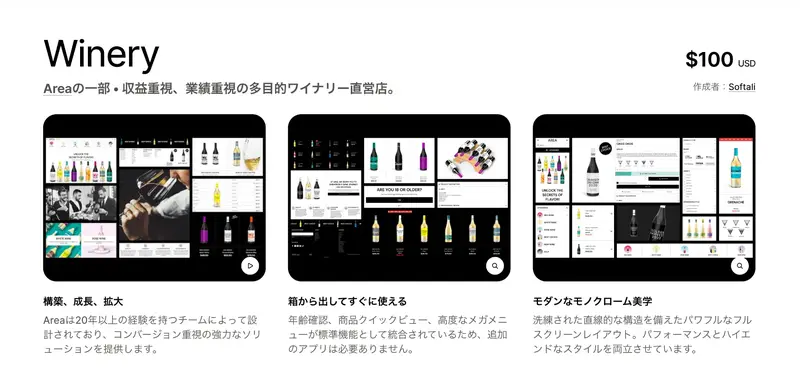
1. Winery
Winery is a preset for wine shops within the Shopify theme "Area". It comes standard with features such as age verification and quick product views, eliminating the need for additional apps. Its linear, modern layout allows you to create a sophisticated website.
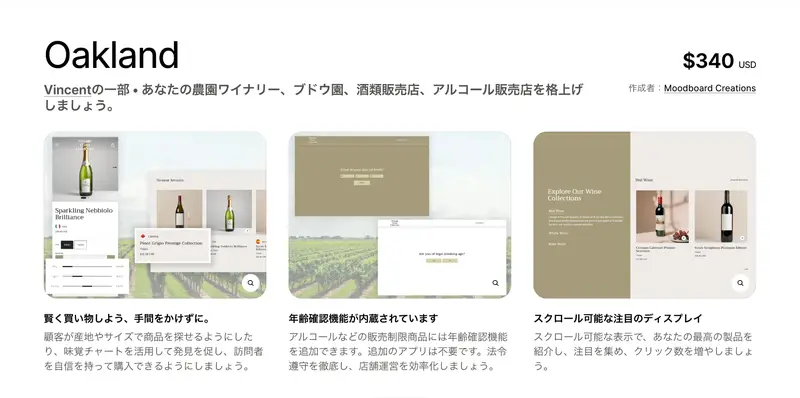
2. Oakland
Oakland is a wine sales preset for the Shopify theme "Vincent." It allows you to filter products by region and other criteria, and provides a taste chart that visually conveys acidity, sweetness, body, and other characteristics.
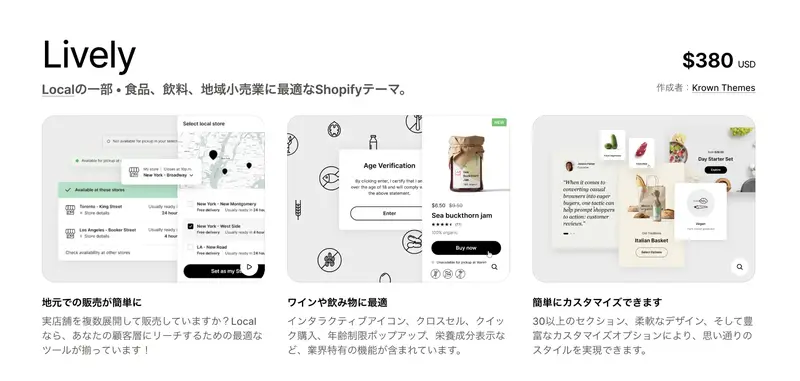
3. Lively
Lively is a preset for the Shopify theme "Local" specifically for groceries and beverages. It includes a store pickup service, making it suitable for shops that operate both an e-commerce site and a physical store.
To start selling wine online, you need to select products, define your target market, secure suppliers, obtain a mail-order alcoholic beverage retail license, build an e-commerce website, and establish storage and delivery systems. Since applying for a wine sales license takes time, start preparing early and work on multiple tasks simultaneously.
After sales begin, making it easier for customers to find a wine that suits them by allowing them to search by origin and taste, and by providing information on food pairings and the producer's background. It is also effective to incorporate sales methods that are compatible with wine, such as set sales, gifts, and subscription services.
Shopify allows you to manage all the necessary functions for running a wine e-commerce business, including product management, payment processing, shipping, and inventory management, all in one place. You can also utilize themes and apps suitable for wine sales, enabling you to build an e-commerce site that balances your brand's world view with ease of purchase.
Frequently Asked Questions about Online Wine Sales
Can individuals sell wine online?
Even individuals can sell wine online if they meet the requirements for a mail-order alcoholic beverage retail license. Being a corporation is not required.
However, you will need to undergo a review process regarding your sales location, suppliers, financial plan, and sales methods. Before starting your business, consult with the tax office that has jurisdiction over the location of your sales location.
Do you need a license to sell wine?
To sell wine, you need a liquor sales license depending on your sales method. If you sell online, you need a mail-order liquor retail license. Qualifications such as sommelier or wine expert are not required.
In addition to a license, each sales location must appoint a person who has completed alcohol sales management training within the past three years as the alcohol sales manager. After appointment, the person must be required to take training at intervals not exceeding three years.
How long does it take and how much does it cost to obtain a mail-order alcohol retail license?
The standard processing time for a mail-order alcohol retail license is generally within two months of application. However, this does not include the time required for additional document submissions or corrections, so it may actually take longer. Additionally, a registration tax of 30,000 yen per license is required upon issuance. Since preparing the application documents also takes time, it's advisable to start the process well in advance, working backward from your planned sales start date.
Share this article
- Share on Facebook
- Share on X
- Share on LinkedIn



