 跨境独立站开店
This article introduces how to create a subscription service and useful apps for getting started.
Subscription services are an effective business model for generating recurring revenue. This guide provides a clear explanation of how to create a subscription service for those who want to start a business using this model.






This article introduces how to create subscriptions and a convenient Shopify app that makes managing your subscription business easy.
This article provides a clear explanation of subscription services and how to create them.
What is a subscription?
A subscription is a business model where customers pay a regular fee to continuously use a product or service. For companies, it offers advantages such as stable revenue and easier building of long-term relationships with customers.
In recent years, this technology has been increasingly adopted in a wide range of industries, including software and content distribution, food, and clothing, enabling flexible delivery and personalization tailored to user behavior. This is expected to improve customer satisfaction and foster longer-term relationships.
How to create a subscription service: 5 steps
1. Confirm the demand for the product or service.
It is crucial to determine whether the products and services you offer are in demand by customers. Even if you offer a low-priced, innovative subscription service, it will be difficult to run as a business if few people want it or find it appealing. Conduct thorough research on the products and services you want to handle beforehand and confirm whether they have potential for business growth.
2. Choose the appropriate subscription model.
Once you've completed your demand research, the next step is to choose the appropriate subscription model. There are four main subscription models:
- Membership-based model
- Subscription model
- Recommendation Model
- Subscription model
The membership model is a service model where services are provided to members who pay a monthly or annual fee. It is one of the popular subscription service models, and is well-known for music streaming and video streaming. It is also used when offering discounted or limited-edition products under a company's own brand, or when providing all-you-can-eat or all-you-can-drink options at restaurants.
A subscription model is a service where a specific product is delivered to a customer on a regular basis. It is well-suited for providing consumables such as diapers and detergent. For customers, it not only saves them the trouble of ordering each time, but also helps avoid situations such as running out of stock.
Furthermore, subscription plans are often offered at a discounted price, resulting in a high retention rate.
A recommendation model is a system that delivers products selected to match the customer's preferences and hobbies. Typical products include apparel, beauty products, and pet food. Based on a pre-purchase questionnaire, personalized recommendations are provided.
Even after the subscription service launches, we continue to analyze customer preferences by asking them to complete surveys and collecting their feedback on the products. This allows us to accumulate data with each customer, making it easier to provide products that are tailored to their individual needs.
The subscription model is a type of subscription service where the service provider selects and delivers products to the customer. It differs from the recommendation model in that the company selects and decides on popular products, new products, and recommended items. The subscription model offers customers the surprise experience of not knowing what they will receive. This model is used in various fields, including cosmetics, food, and flowers.
3. Determine the details, frequency, and price of the service.
Once the subscription model is decided, details such as the service delivery method, frequency, and pricing are determined. Competitive analysis and 3C analysis are conducted, and the details and frequency of the service are determined based on the results.
For example, in a membership-based model, you would decide whether to offer multiple pricing plans with different service levels. Or, in a recommendation model, you would decide whether the selected products are for purchase or rental, whether to set a minimum order requirement, and so on.
Subscription services have a low barrier to cancellation, so it's necessary to devise strategies to encourage continued use. Analyzing the behavior of your target audience using customer journey maps and other tools to implement countermeasures is highly recommended.
Furthermore, even if you offer an attractive service, if the pricing is too high, potential customers won't use it. It can also lead to cancellations from customers who signed up using initial promotional offers. Since subscriptions involve regular payments, it's crucial to set a price that customers feel they can afford to pay consistently. Please also refer to our article on pricing strategies.
4. Develop a marketing strategy.
Let's develop a marketing strategy that not only makes your company's subscription widely known, but also encourages continued use. Marketing methods mainly include the following:
- Instagram marketing and other social media marketing
- Video Marketing
- Email Marketing
If you offer subscription plans at various price points, it's crucial to design them in a way that clearly shows the differences in price and service content at a glance. Furthermore, consolidating information such as trial periods and contract periods into a single image and posting it on social media platforms like Instagram makes it visually easier to understand. This helps potential customers understand the service more easily and can help prevent them from churn.
A marketing strategy that encourages subscribers to create user-generated content (UGC), such as reviews, on websites and social media is also recommended. This will increase word-of-mouth about the subscription service and lead to increased brand awareness.
5. Build the system
There are mainly two ways to build a subscription-based system:
- Building a system using external services: External systems such as Shopify often come pre-loaded with necessary functions, allowing you to release your service quickly.
- Developing a system in-house: Developing a system in-house offers the advantage of flexible customization to suit the services being provided. However, it requires technical expertise, time, and expense because the system must be built from scratch.
4 Recommended Subscription Management Apps for Shopify
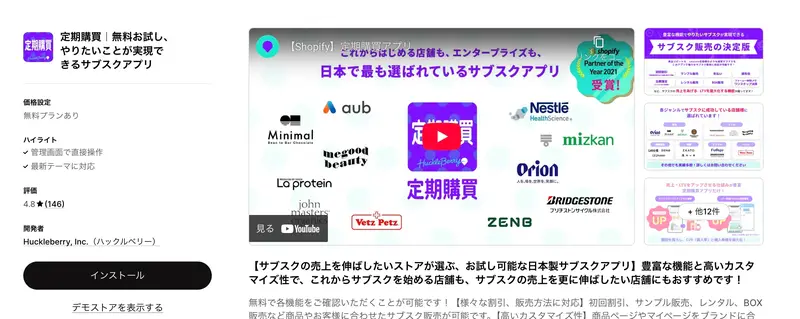
Regular purchase
This is a Japanese-made subscription app. It's recommended for those offering a subscription service for the first time, as you can try out its features for free. It's also known for providing a suite of "user-friendly subscription" features, such as no minimum purchase requirement and easy cancellation procedures, ensuring customer peace of mind.
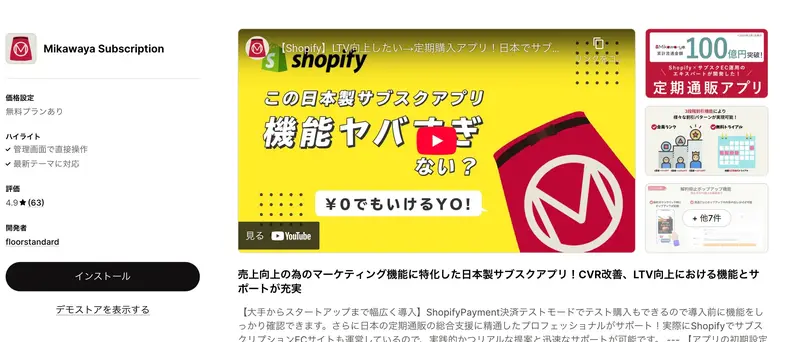
Mikawaya Subscription
This subscription app has received high ratings from app users. It specializes in marketing features, allowing users to test purchases using the test payment function to verify functionality. This tool was developed by developers who actually operate e-commerce sites.
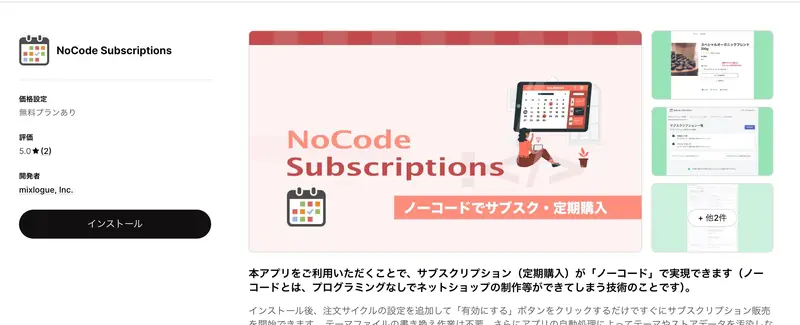
No-Code Subscriptions
This app is recommended for those who want to start offering subscriptions at a reasonable price. Since you can implement subscription functionality without coding (no programming required), you can easily get started even without specialized knowledge. Furthermore, a major advantage is that the usual fees incurred for each subscription registration are waived for paid subscription plans.
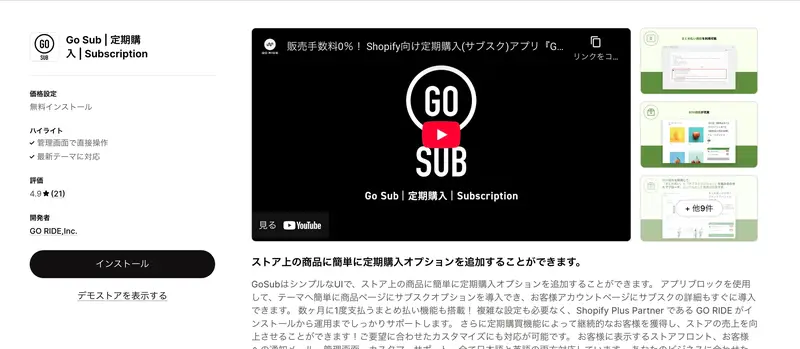
Go Sub | Subscription
This app has a simple UI and makes it easy to add subscription options. It is fully compatible with Japanese and is customizable.
How to set up a subscription on Googleify
1. Install the subscription app.
To set up subscriptions on Shopify, install the subscription app in your shop. For the subscription app to work, your store must use a payment service such as Shopify Payments. Region-specific payment methods, such as Klarna and iDEAL for mobile, are not supported for subscription products. Please check the subscription settings page for the conditions for offering subscriptions.
2. Set up the subscription app.
Complete the setup within the installed subscription app. The settings will vary depending on the app you are using. Afterward, complete the subscription app settings in the management screen.
3. Add or edit subscription policies
When you set up a subscription, a cancellation policy page for the new purchase option will be added to your store's admin panel. This cancellation policy will be the "subscription policy" displayed during checkout, so add or edit the policy content to suit the services you provide.
4. Set up a subscription product.
From the admin panel, click "Products," then click the product you want to set up as a subscription. If you want to sell the product only as a subscription, check the box for "Sell product only as a subscription." If you want to allow one-time purchases as well as subscriptions, uncheck the box.
Benefits of creating a subscription service
- Revenue is easy to predict.
- Recurring revenue
- Easy to enter regardless of industry or sector.
- Easy to upsell and cross-sell.
1. Revenue is easy to predict.
Subscription businesses have the advantage of being able to predict revenue based on the number of subscribers. Since customers pay in the form of monthly or annual fees, monthly and yearly revenue can be predicted based on the number of customers and subscription fees. Being able to predict revenue makes it easier to understand cash flow.
2. To generate continuous revenue
One of the attractions of subscription services is the potential for continuous revenue.
Unlike a one-time purchase model, subscription services allow you to generate revenue regularly, such as monthly or quarterly. To ensure continued service usage, it's essential to focus on providing high-quality service that encourages customer retention. Once established, subscription businesses can generate passive income, making them an effective way to earn money from home.
3. Easy to enter regardless of industry or sector.
Subscriptions are a business model that is easy to enter and start because they are used in a wide range of industries and sectors. They are not limited to software and video/music streaming; they are also implemented in a broad range of fields such as food, cosmetics, and fashion. In addition to subscriptions for large items like cars, motorcycles, and furniture, there are also experiential subscriptions that allow participation in events, and subscriptions that allow unlimited stays in designated homes. Beyond established business models in various industries and sectors, it may also be possible to attract attention and achieve success as a subscription business by introducing new ideas.
Furthermore, since it can be started on a low budget, it is recommended for entrepreneurs who want to keep initial costs down, as well as for people looking for ways to earn money from home.
4. Easy to upsell and cross-sell.
The subscription business model has the advantage of making upselling and cross-selling easier. It can be expected to be highly effective in promoting new products and services, and based on accumulated data on customer preferences and hobbies, it is possible to propose products and services that meet customer needs, and cross-selling of one-time purchase items and upselling of subscription plans can be expected.
Disadvantages of offering subscriptions
- High cancellation rate
- It takes time to attract a certain number of customers.
- It takes effort to encourage first-time purchases.
1. High cancellation rate
Subscription services tend to have high cancellation rates, so it's essential to implement strategies to encourage continued use.
For example, it's crucial to accurately understand customer needs, offer solutions that address those needs, and provide high-quality customer support. Furthermore, regularly introducing new products and reviewing benefits can help maintain and improve the attractiveness of the service.
2. It takes time to attract a certain number of customers.
Subscription services take time to attract a certain number of customers. If you're just starting out with a subscription business, you need to implement the marketing strategies mentioned above to aim for both acquiring new customers and retaining existing ones. Since it's expected that it will take time for a subscription business to become profitable, you should create a business plan that takes these factors into consideration.
3. It takes effort to encourage first-time purchases.
Unlike products purchased on a one-time basis, subscriptions are based on the premise of continuing for a certain period of time, so many people hesitate to make an initial purchase due to resistance to regular expenses.
To reduce customer resistance, measures such as offering a free trial period, a free first month, or a starter plan are necessary.
In recent years, subscription services have gained attention across a wide range of industries and sectors, making them a popular business model not only for entrepreneurs but also for startups. Shopify's subscription app allows you to start a subscription business without coding knowledge and offer recurring purchase options tailored to customer needs. Beyond being an e-commerce platform, Shopify also offers Shopify POS, which supports sales management in physical stores. This centralized approach to accounting and sales management makes it ideal for those who want to operate a multi-channel business encompassing both e-commerce sites and physical stores.
read more
- COHINA's Merchant Story: Delivering perfectly sized clothing for petite women - COHINA
- 12 Ways to Sell Intangible Goods Online
- How to create a members-only website with Shopify
- [Must-Read Guide] Introducing Payment Services You Can Use with Shopify
- 30 Stylish E-commerce Sites Built with Shopify, Selected by Designers
- This guide explains how to set up and specify a domain name for your online shop.
- How to take the best apparel photos for online shops
- Basic Knowledge of Cross-Border E-commerce Logistics: An Introduction to the Characteristics and Methods of International Shipping
Frequently Asked Questions about Subscription Services
What are some examples of subscription services?
Examples of subscription services include music streaming services like Spotify and LINE Music, video streaming services like Netflix and Hulu, and food delivery services like Oisix and Radish Boya.
What is a subscription service in simple terms?
What are some recommended Shopify apps for subscriptions?
Recommended Shopify apps for subscriptions include the Japanese subscription management app "Teiki Kouhin" (Regular Purchase), the highly-rated "Mikawaya Subscription," and "NoCode Subscriptions," which requires no programming knowledge whatsoever.
Can sole proprietors start a subscription business?
Individual business owners can also start a subscription business. Those aiming to start a new business with a subscription model should refer to "How to Establish a Company."
Share this article
- Share on Facebook
- Share on X
- Share on LinkedIn



