跨境独立站开店
Store design | Design Thinking: A 5-Step Process
Design thinking is an innovative framework for solving complex problems with flexible thinking.
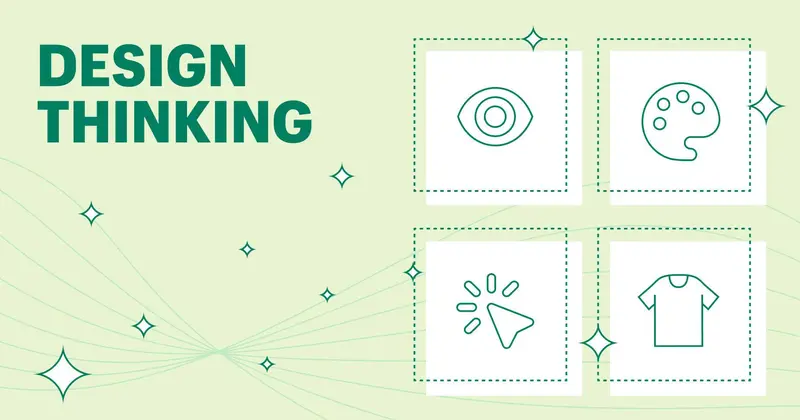
Design thinking is an innovative framework for solving complex problems with flexible thinking.
Design refers to the relationship between function and aesthetics in artifacts. From primitive hunting tools to palm-sized computers, a wide variety of things have been "designed." Can design function effectively as a business science—that is, as a method for creating and innovating how people interact with the world? This is the fundamental idea behind design thinking. The empathy-driven, step-by-step process of design thinking can expand markets, increase revenue, and play a central role in the development of new products and services.
Many groundbreaking technologies and social innovations that are now known to everyone, such as Apple's iPhone, Uber's ride-hailing app, and Netflix's streaming algorithm, originated from design thinking methodologies. This article will show you how to apply design thinking to business.
What is design thinking?
Design thinking is a human-centered framework that generates flexible solutions to complex problems. It involves repeatedly testing and validating ideas to ultimately arrive at the best possible outcome. This framework can be applied to product development, website conversion rate optimization, logo design, and more.
Regardless of the context in which it is used, design thinking has the following characteristics:
- Human-centered. Design thinking is a user-centered approach. Its goal is to identify and solve the unmet needs of those receiving the service. Creative problem-solving using design thinking means not simply testing hypotheses, but gaining a deeper understanding of the target customer. Design thinking emphasizes the "society" in social innovation.
- Iterative. Design thinking is a highly iterative process. It doesn't always proceed in a sequential manner; frequent reflection is necessary, and sometimes you might take a step back only to suddenly take two steps forward. You create mockups and prototypes of ideas, gather feedback, and test and rethink the ideas at various stages.
Five stages of design thinking
- Coming up with ideas
- Create a prototype
- Release, observe, restart
1. Empathy
In the "empathy" stage of design thinking, research is conducted to thoroughly understand the needs of the target market. First, market research is carried out to grasp customer experiences and expectations. The goal at this stage is not to solve complex problems or test hypotheses. The goal is to ask questions and identify the problem. It is also recommended to create a problem statement to communicate the background of these problems to team members.
Conducting interviews and surveys are also good methods. You can gain a deeper understanding by putting yourself in the customer's shoes. Building trust requires conscious effort. For example, if you're making running shoes, you might need to go out on the track yourself to empathize. If you're making marinades or seasonings, it would be good to observe how people cook at home or experience working in a restaurant kitchen.
2. Definition
Based on the information gathered during the empathy phase, we narrow down our goals. What potential solutions do we want to offer our customers? If you're making camping equipment, you might need to develop lightweight, easy-to-clean cookware—rather than portable versions of everyday appliances—to help customers comfortably enjoy their outdoor adventures. If you're working on UX design, your goal might be to shorten (or lengthen) the time users spend on your app.
Defining goals is central to making design thinking a user-centered approach, guiding companies' focus from market competition to providing services to customers.
3. Idea Generation
In the idea generation phase, we consider flexible solutions to the identified problem. At this stage, it's important to create options rather than making a choice.
This third stage will likely be the most enjoyable part of the design thinking process, as the lack of constraints encourages free-flowing ideas. It's especially important to express original ideas during this period. If you're feeling the urge to answer every problem with "we need to move to Mars first," then now is the time.
4. Prototype creation
During the prototyping phase, ideas are translated into rough models (ideally multiple backup models) to identify which parts are suitable for actual applications and which are not. This is the stage where feasible solutions are considered.
Prototyping helps to anticipate user feedback and determine whether the issues identified in the empathy phase have been resolved. This testing phase saves time and costs. Poorly performing or economically unfeasible models can be eliminated, and a model free of early development bugs can be approved.
5. Release, observe, restart
In the final stage, we release the design and observe its impact on users. Once observed, we restart the design process from the beginning. Design thinking is a cycle of constant innovation and experimentation with no clear end, and there is always room for improvement.
When observing a design, reflect on the initial steps taken to empathize with the customer. Evaluate whether their needs and expectations were met. Did it solve the problem it was trying to solve? Did actually bringing the design to life provide any new insights?
By reflecting in this way, design thinking becomes iterative and human-centered. Every release is seen not as a conclusion, but as an iteration that serves as a starting point for refining the concept, with a focus on human experience rather than metrics.
How to apply design thinking to your work
Learning when and how to incorporate design thinking into your business takes time. Start by applying the principles of design thinking to everyday situations and identifying which methods generate ideas worth trying. Here are some key principles to keep in mind:
- Embrace uncertainty. In the initial stages, you may encounter problems that seem too difficult to solve. In such cases, instead of giving up, view those problems as a path to new ideas.
- Learn from your mistakes. Design thinking is a forgiving process where trial and error and effort are rewarded. Suppress the urge to give up just because things don't go well the first time. Instead, view failure as one possibility for finding a solution, and use that experience to your advantage in future endeavors.
- Question assumptions and conclusions. The initial stages of design thinking aim to discard preconceived notions about customer desires and needs. Even after releasing a successful idea, use design thinking to rethink and improve it.
Design thinking is a skill, and like any skill, it requires practice. When design thinking works, new ideas emerge from open-minded engagement. The more you use this method with your team members, the more moments of sudden realization you'll experience, and the more confident you'll become in your creativity.
Frequently Asked Questions about Design Thinking
What is design thinking?
Do not confuse design thinking with design principles. Design thinking is a human-centered design framework for building alternative solutions to complex problems.
What are the stages of design thinking?
Design thinking has five stages: empathy, definition, idea generation, prototyping, and release/observe/restart. While these stages are typically followed in order, design thinking itself is not necessarily a sequential process, and it is recommended to re-examine the conclusions reached at each stage and raise questions.
Who coined the term "design thinking"?
Cognitive scientist and Nobel laureate Herbert A. Simon proposed the concept widely known as design thinking in 1969. Since then, many other thinkers and design teams have criticized and redefined design thinking. Rethinking design thinking has evolved the key principles of this process.
Share this article
- Share on Facebook
- Share on X
- Share on LinkedIn