跨境独立站开店
What is inventory optimization? Methods and best practices
This article introduces the meaning, methods, and best practices of inventory optimization. Review the latest AI-powered inventory optimization techniques to help you manage your inventory efficiently.

This article introduces the basics, methods, and best practices for inventory optimization.
Excessive inventory leads to increased storage costs and worsened cash flow, while conversely, insufficient inventory can result in lost sales opportunities due to stockouts. Maintaining the right balance of inventory requires sophisticated demand forecasting and order control. In recent years, AI tools have been increasingly used to implement more accurate inventory planning without relying on experience or intuition.
This article explains the basic concepts of inventory optimization, how it differs from inventory management, its main methods, and best practices.
What is inventory optimization?
Inventory optimization is the process of ensuring that necessary products are available in the right quantities at the right time. Too little inventory can lead to lost sales opportunities and decreased customer satisfaction. On the other hand, too much inventory not only increases storage and management costs but also raises the risk of dead stock and waste.
To effectively manage these conflicting risks, it's necessary to accurately forecast demand and procurement lead times, and continuously update optimal inventory levels. By maintaining appropriate inventory levels in line with demand, you can avoid missing sales opportunities and minimize the costs of excess inventory that can negatively impact profits.
Efforts to optimize inventory
Inventory optimization is not just about managing inventory levels to keep them as low as possible. To properly adjust inventory, the following measures must also be taken in parallel:
- Detailed analysis of demand: Based on past sales data, we predict the required inventory levels. We also need to take into account the seasonality of each product and the effectiveness of any ongoing campaigns.
- Adjusting Order Timing: We calculate safety stock levels that allow for a buffer to handle supply problems. We also consider the lead time from the supplier until the goods arrive and determine the reorder point—the threshold at which we will place an order.
- Inventory allocation by location: If you have multiple warehouses or stores, analyze the differences in demand at each location and determine the allocation. Also, establish plans for moving inventory between locations as needed.
The difference between inventory optimization and inventory management
Inventory management refers to the practical management of accurately knowing which products are currently in stock, where they are located, and in what quantities. Inventory optimization is a strategic layer aimed at improving productivity and maximizing profits. While these concepts are closely related, they differ in purpose and scope. The main differences are as follows:
Inventory Management
Inventory Optimization
Accurately track and manage the quantity and condition of inventory.
To improve productivity and profits, develop strategies for inventory levels and placement.
Target tasks
Receiving and shipping procedures, ordering, bookkeeping, warehouse organization, etc.
Analysis of demand forecasts, safety stock levels, reorder points, and other factors for business decision-making.
Data to be handled
Real-time inventory, number of items received, number of orders
Historical sales data, seasonal demand fluctuations, costs, lead time
Why inventory optimization is becoming increasingly important
In recent years, the importance of inventory optimization has increased due to factors such as the expansion of the e-commerce market, the diversification of consumer needs, and rising logistics and storage costs. In an environment where inventory management is becoming more complex, determining inventory levels based solely on past experience makes stockouts and excess inventory more likely.
The main reasons why more strategic inventory optimization is becoming important are as follows:
- The e-commerce market is expanding: According to the Ministry of Economy, Trade and Industry, the domestic B2C e-commerce market size in 2024 reached 26.1 trillion yen, a 5.1% increase from the previous year. Of this, the merchandise sales sector accounted for 15,219.4 billion yen, and the increase in the number of orders and delivery volumes is leading to increased costs and lead times, impacting inventory management plans across various industries.
- Responding to changing demand: As consumer needs have diversified, product life cycles have shortened. Therefore, missing signs of changing demand can lead to large amounts of unsold inventory and lost opportunities.
- The cost of excess inventory needs to be reduced: Storage and management costs are rising, and holding too much inventory can strain business operations. Losses can also be incurred through discounted sales or disposal.
- The need to manage multiple channels and locations is increasing: Omnichannel strategies that link e-commerce sites with physical stores are becoming more widespread, and there is a growing need to appropriately allocate inventory according to the demand of each channel.
- Data and AI are becoming easier to utilize: Numerous AI agents for business use have emerged, enabling demand forecasting and order volume calculations to be performed more quickly and with greater accuracy.
In recent years, inventory optimization has become more important than ever to cope with market changes and rising costs. Meanwhile, advancements in technologies such as data utilization and AI tools have lowered the barriers to implementation and significantly improved accuracy. As a result, inventory optimization has become an essential practice for retailers.
Inventory optimization mechanism
Inventory optimization is a system that determines the optimal inventory level and ordering timing for each product based on data such as sales performance, demand forecasts, and procurement status. It doesn't simply look at the current inventory level, but also considers lead time, supplier supply status, storage costs, seasonal fluctuations, campaigns, returns, and inventory movements.
The main steps are as follows:
- Collect data: Understand sales performance, inventory levels, expected arrival dates, lead times, etc.
- Forecasting demand: Forecast future demand for each SKU, store, warehouse, and sales channel.
- Setting optimal inventory levels: Based on demand forecasts, determine safety stock levels, reorder points, and order quantities.
- Inventory allocation: Place products in the appropriate locations according to the demand at each site.
- Continuous review: Check the difference between actual sales and forecasts, and adjust inventory levels and ordering conditions.
Main methods of inventory optimization
- Demand forecast
- Setting safety stock and reorder points
- ABC analysis
- Setting EOQ (Economic Order Quantity) and Minimum/Maximum Inventory Levels
- Optimizing inventory across multiple locations
Demand forecasting is a method of predicting future sales by analyzing data such as past sales performance, seasonal fluctuations, campaigns, and trends. Based on these forecasts, indicators such as how much inventory is needed and by when are determined.
For example, if a product sees increased demand in the summer, we secure inventory before demand rises. On the other hand, to ensure sufficient warehouse space, we limit the order quantity for products where decreased demand is expected.
To improve the accuracy of demand forecasting, it is important to analyze multiple factors in combination, including not only sales performance but also demand by sales channel and store, lead time, sales, events, and return trends. It is also necessary to regularly check the difference between forecasts and actual results and revise the model and assumptions. By making accurate demand forecasts, it becomes easier to reduce both lost sales opportunities due to stockouts and storage costs due to excess inventory.
Safety stock refers to inventory kept in excess of the optimal level to prepare for unpredictable fluctuations such as sudden increases in demand or delivery delays. The reorder point refers to the threshold at which a new order is placed when inventory levels fall to a certain level. Both are important concepts for preventing stockouts while avoiding excessive inventory.
For example, for products that take time to arrive after procurement, the quantity to be sold during that period is estimated, and a safety stock is added to the appropriate inventory level as needed to set the reorder point. Products with large fluctuations in demand or those with unstable delivery times from suppliers require a larger safety stock level.
However, increasing safety stock too much increases storage costs and the risk of excess inventory. Setting safety stock and reorder points appropriately makes it easier to balance the risk of stockouts with inventory costs.
ABC analysis is a method of classifying products into three ranks, A, B, and C, based on their importance, such as sales revenue or profit, and then determining their priority. Instead of managing all products using the same criteria, changing the management method according to importance allows for efficient inventory optimization.
Generally, products that contribute significantly to sales and profits are classified as A-rank, those with a moderate contribution as B-rank, and those with a relatively low contribution as C-rank. Because A-rank products are greatly affected by stockouts, demand forecasts and reorder points are reviewed closely, and a larger inventory is always maintained. On the other hand, C-rank products are less affected by reduced management frequency, and in some cases, inventory disposal and replacement with other products may be considered.
However, classifying products solely by sales revenue or profit margin may cause you to overlook seasonal items, products reflecting the latest trends, or products that have synergistic effects with other products. Even for products classified as C-rank, it is important to analyze their sales performance during specific periods and the products they are purchased with, and make individual judgments. Utilizing ABC analysis makes it easier to concentrate limited management resources on important products.
EOQ (Economic Order Quantity) is the order quantity that minimizes the combined cost of ordering and storing inventory. Ordering large quantities at once reduces the number of orders but increases storage costs and the risk of excess inventory. Conversely, ordering small quantities at a time keeps inventory down but increases the number of orders and the effort involved. EOQ represents the inventory level and ordering timing that strikes a balance between these two extremes.
In addition, setting minimum and maximum inventory levels is also an effective method. The minimum inventory level is a standard that must not be lowered to avoid stockouts, while the maximum inventory level is an upper limit that must not be exceeded to prevent excess inventory. These levels should be set based on factors such as demand, lead time, storage space, product expiration dates, and obsolescence risk.
By establishing these standards for each product, order quantities and inventory levels can be managed according to consistent rules, reducing the workload. However, since demand and procurement conditions change, it is important to review the set values regularly.
When managing multiple stores, warehouses, and distribution centers, it's necessary to understand the overall inventory and allocate it appropriately according to the demand at each location. Managing inventory individually at each location can easily lead to imbalances, such as some stores running out of stock while others have excess inventory. Furthermore, when shipping products to customers, using a physically close location reduces delivery time and costs.
By visualizing sales and inventory levels at each location in real time, it becomes possible to move inventory between stores or warehouses as needed, or to prioritize allocating products to areas with high demand. Furthermore, a system is needed that allows for centralized management of inventory across channels, such as e-commerce and physical stores, without fragmentation.
AI-powered inventory optimization
The key feature of AI-powered inventory optimization is its ability to analyze large amounts of data and multiple variables simultaneously, which would be difficult to process manually, and to predict demand in detail at the SKU and store level. For example, it becomes possible to utilize complex forecasting models that combine not only sales history but also seasonality, price range, promotional campaigns, lead time, and demand differences between stores. Furthermore, it is possible to analyze multiple future scenarios by calculating reorder points based on the balance between service levels and inventory costs.
To utilize AI, you need to prepare the following data and systems:
- Accurate sales data by SKU, store, and sales channel.
- Inventory information that is updated frequently, such as stock levels and expected arrival dates.
- Data that influences demand, such as lead time, promotions, and seasonality.
- A system that compares prediction results with actual results and continuously improves the model.
In fact, in Japan, the home improvement retailer Cainz has implemented demand forecasting using Google Cloud's Vertex AI. According to Google Cloud, as of August 2024, the demand forecasting AI has been deployed in 209 stores, enabling more accurate predictions of reorder points for inventory replenishment, taking into account short-term sales trends, including seasonal products that were previously difficult to predict.
In AI-driven inventory optimization, it is crucial to prepare accurate data and continuously improve the predictive model through comparison with actual results. Rather than simply accepting AI predictions at face value, using them as a tool to support human inventory decisions will make it easier to respond to fluctuations in demand.
Best practices for inventory optimization
In inventory optimization, the goal is not simply to reduce inventory levels, but to continuously operate a system that prevents stockouts while keeping excess inventory under control. For example, the following initiatives are effective:
- Improving the accuracy of inventory data: We immediately reflect inventory fluctuations due to incoming and outgoing shipments, returns, cancellations, and inter-location inventory transfers in the system, and conduct regular inventory counts. If there are discrepancies between actual inventory and system inventory, we identify the cause and review any input errors or processing methods.
- Management methods vary depending on the importance of the product: Using ABC analysis, A-rank products, which contribute significantly to sales and profits, are checked frequently regarding inventory status and reorder points. On the other hand, C-rank products are checked less frequently, setting management priorities for each product.
- Update operational rules at appropriate times: Compare demand forecasts and actual results at regular intervals, such as monthly or weekly, and review them at times when demand is likely to change, such as before and after sales, new product launches, and seasonal changes. Also, adjust safety stock levels and reorder points in response to these changes.
- Create a system that allows inventory to be shared between locations: This involves centrally managing inventory at each store and warehouse, and establishing a system that allows surplus goods at one location to be moved to a location with high demand.
- Regularly review KPIs: Check inventory turnover rate, stockout rate, and inventory holding days for each product and location, and improve the items with the largest discrepancies from the target.
If you have a large number of SKUs or sales locations, it is effective to automate and streamline these tasks using inventory management systems and AI. The important thing is not to just set rules and be done with it, but to continuously improve based on sales performance and changes in demand.
How to optimize inventory using Shopify
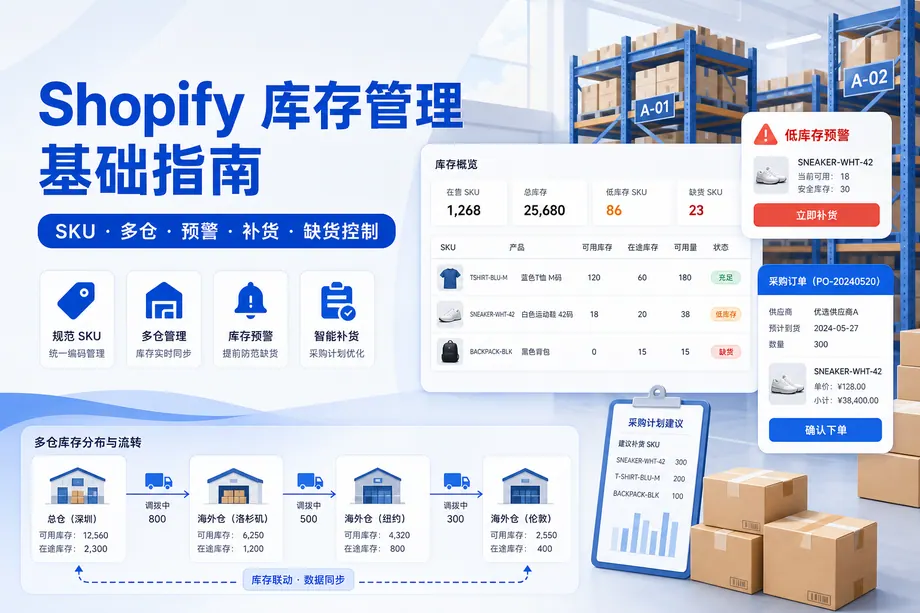
Shopify allows you to centrally manage inventory information across multiple sales channels, including online stores, physical stores, and B2B. By understanding inventory status at each store and warehouse, you can make informed decisions regarding inventory transfers and replenishment, making it ideal for optimizing inventory across multiple locations.
The main features that help optimize inventory are as follows:
- Inventory management across multiple locations: Understand inventory levels at each store and warehouse, and check inventory status at each location.
- Inventory Transfer: Allows for accurate tracking of the movement of goods from locations with excess inventory to locations with shortages.
- Shopify Flow: Automates inventory management workflows, such as notifications when inventory falls below a certain level.
- Reporting and analysis functions: You can check sales performance and inventory data and use it to make decisions about replenishment and purchasing.
- Integration with external systems: Depending on the scale of the business, we integrate with ERP and inventory management applications to perform more advanced inventory management.
Furthermore, Shopify's AI assistant, Sidekick, can be used for tasks such as analyzing inventory data. Shopify's official help documentation also explains how to use Sidekick to analyze inventory balances and create inventory transfers.
Inventory optimization is the effort to maintain appropriate inventory levels by minimizing both stockouts and excess inventory. While inventory management is the task of accurately understanding and managing current inventory, inventory optimization aims to improve profits and efficiency by determining "which products should be kept, where, and in what quantities."
In the e-commerce market in particular, the importance of flexibly reviewing inventory strategies is increasing due to rising logistics costs and the growing complexity of demand fluctuations. At the same time, the ability to utilize AI for demand forecasting, ordering, and inventory allocation has made it possible to optimize inventory more accurately and easily. Please refer to this article and try to optimize your inventory to maximize profits and productivity.
Frequently Asked Questions about Inventory Optimization
Is inventory optimization necessary even for small and medium-sized enterprises?
For any company that handles inventory, inventory optimization is crucial regardless of size. Especially for small and medium-sized enterprises (SMEs), excess inventory can have a significant impact on cash flow, so it's advisable to prioritize reviewing best-selling items and those prone to stockouts.
How often should inventory optimization be reviewed?
While it varies depending on product characteristics and sales cycles, it's important to review your inventory whenever demand or lead time changes. For seasonal or trendy products with significant demand fluctuations, reviews should be conducted at shorter intervals.
What should I start with when beginning inventory optimization?
First, we will establish a system that allows us to accurately grasp current inventory levels, sales performance, stockout status, and excess inventory. Then, it will be easier to proceed by prioritizing the review of demand forecasts and ordering conditions for best-selling products and products with high inventory value.
What tools are available for inventory optimization?
Inventory management systems, ERP systems, demand forecasting tools, POS systems, and e-commerce platforms can be utilized. By choosing a tool that allows for centralized management of sales and inventory data, you can streamline inventory management and ordering decisions.
Share this article
- Share on Facebook
- Share on X
- Share on LinkedIn