跨境独立站开店
How to start dropshipping and dropshipping service providers (DSPs)
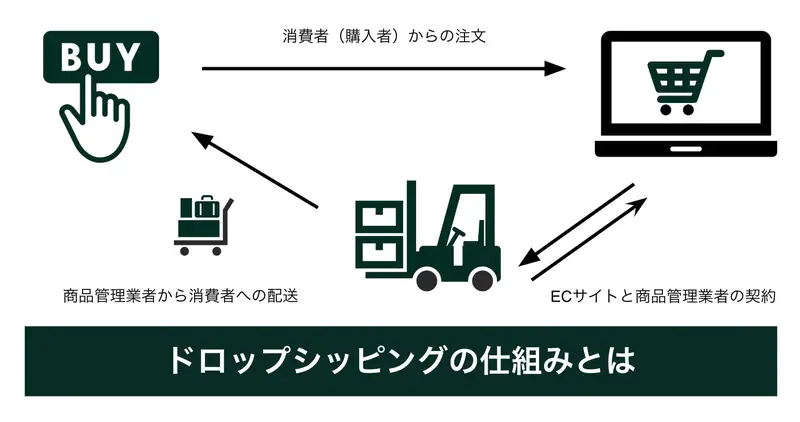
Dropshipping is a business model where products are sold without holding inventory. Because suppliers such as manufacturers and wholesalers handle packaging and shipping, it allows online shops to operate with reduced risk and effort.
This article provides a detailed explanation of the different types of dropshipping, how to get started with each, and recommended providers.
Dropshipping is a business model where products are sold without holding inventory. Because suppliers such as manufacturers and wholesalers handle packaging and shipping, it allows online shops to operate with reduced risk and effort.
This article explains how to get started with dropshipping, broken down by type. We'll also introduce recommended dropshipping providers, common mistakes, and their solutions, so please use this as a reference when launching your dropshipping business.
There are three types of dropshipping.
1.DSP type
This method involves selling products through a DSP (Dropshipping Service Provider) that handles products for dropshipping. It's an easy method to implement even for beginners and is the most popular of the three types of dropshipping. On the other hand, because it's a business model that doesn't involve holding inventory, it's difficult to increase profit margins by not being able to purchase products at discounted prices through bulk purchases, and it's difficult to differentiate from competitors in terms of products offered and pricing.
2. Direct contract type
This is a sales model where you directly contract with manufacturers and wholesalers to conduct dropshipping. Because you find the products you want to handle yourself, you have the advantage of being able to offer products different from your competitors. Also, compared to DSP models, there are fewer competitors selling the same products, making it easier to avoid price competition. However, it requires direct negotiation and contracting with manufacturers and wholesalers, which is time-consuming and laborious. Presentation and negotiation skills are also necessary, making it unsuitable for beginners.
3. Original merchandise sales model
This method involves selling original goods such as smartphone cases and eco-bags featuring illustrations or logos you've designed yourself. By utilizing on-demand printing services, you can place orders as soon as an order is received. While some preparation time is needed to incorporate logos and illustrations into product images, some on-demand printing services provide tools to easily create designs and product images.
How to get started with dropshipping
How to get started with DSP-type dropshipping
To start DSP-type dropshipping, you first need to register with a DSP service that connects businesses looking to purchase goods with suppliers. Once registration is complete, you can set up your own online store using an e-commerce platform such as Shopify.
Next, select the items you want to sell from the products offered by the supplier and list them on your online shop. Since demand fluctuates depending on the season and trends, select products according to the time of year. Once you're ready to sell, use social media and other means to attract customers, and when an item sells, contact the supplier to have them handle the packaging and shipping.
How to get started with direct contract dropshipping
In direct contract dropshipping, you prepare a trustworthy online shop and presentation materials in preparation for negotiations with manufacturers and wholesalers. Once ready, you contact companies that handle the products you want to sell and negotiate the terms. After the contract is finalized, you list the agreed-upon products on your online shop and begin selling. When a product is purchased, contact the contracted manufacturer or wholesaler to request shipping.
How to start a dropshipping business selling original merchandise
To start a dropshipping business selling original merchandise, you first need to register with a print-on-demand company. Next, you'll create designs for the products you'll be selling. In addition to using design software, you can easily create merchandise without specialized knowledge by using the design tools provided by each company.
Once the design is complete, you can upload product images to your online shop and start selling. When a customer purchases a product, you can place an order with a print-on-demand company, which will handle everything from manufacturing to packaging and shipping. Some services can be integrated with your online shop, automatically sending order information to the company each time a customer makes a purchase, ensuring smooth shipping.
Points to keep in mind when starting dropshipping
When selling products through dropshipping, be careful about stock shortages. Dropshipping companies often sell the same products on other e-commerce sites as well, meaning you share inventory with competitors. As a result, sellers cannot control the inventory status of manufacturers or suppliers. This can lead to problems such as being unable to ship products even after they have been sold, or missing delivery deadlines, so be sure to check inventory status regularly.
Key points for choosing a product
When choosing a product, keep the following points in mind.
- Is it likely to be purchased online?
- Is it in line with the trends?
- Can we differentiate ourselves?
- Can we make a profit?
Products that are difficult to find in stores, heavy and difficult to carry home, or products that people are hesitant to buy in stores tend to be purchased online. Also, items that have become popular on TV or social media, or items related to seasons or events, are more likely to be searched for and therefore more likely to be purchased.
One effective way to differentiate yourself from competitors is to choose niche products that aren't widely available on other sites. Niche products can potentially help you avoid price competition with other businesses.
Choosing products that ensure a good profit is essential. Products with high profit margins are ideal, but even with lower profit margins, profits can be secured if sales volume is expected. It's a good idea to choose highly profitable products while considering factors such as the number of competitors and shipping costs.
What is a dropshipping provider (DSP)?
This refers to businesses and websites that handle products available for dropshipping. Dropshipping businesses act as intermediaries between online shops looking to sell products and manufacturers or wholesalers.
Top 3 Dropshipping Service Providers (DSPs): Recommended Japanese Sourcing Sites
NETSEA
NETSEA is Japan's largest wholesale, distributor, and sourcing website. Membership registration is free, making it easy to start dropshipping.
This site features wholesale prices on a wide variety of products, including apparel, general merchandise, furniture, and food, making it ideal for those looking to expand their product range. Please note that you must register as a member to view wholesale prices.
TopSeller
TopSeller is a product sourcing website that handles approximately 300,000 items. To date, it has been adopted by over 1,000 online shops.
Our pricing plans include a free plan where you can freely select up to 5 products, a select course where you can select 300 to 20,000 products depending on the price, and an all-products course where you can list all the products specified for each plan. Monthly fees range from 480 to 4,980 yen for the select course and from 1,980 to 27,800 yen for the all-products course.
Since you can choose a course that suits the size of your e-commerce site, it's ideal for those who want to start a small business and gradually increase their product range.
Wholesale Master
Wholesale Masters is ideal for those looking to dropship in the beauty category, as they handle best-selling diet, beauty, and health products. They also carry everyday necessities and general merchandise, and have a wide selection of low-priced items.
Registration and monthly fees are free, and it supports individual sales as well as bulk orders, making it suitable for individuals who want to easily start dropshipping.
Differences between dropshipping, traditional e-commerce sites, and affiliate marketing.
The difference between dropshipping and traditional e-commerce sites
The difference between dropshipping and traditional e-commerce sites lies in whether or not they hold inventory and the scope of their operations.
Traditional e-commerce sites require businesses to handle all operational tasks, including not only selling, packaging, and shipping products, but also inventory management, customer service, marketing, and branding.
On the other hand, e-commerce sites that use dropshipping primarily handle customer service and marketing and branding necessary for product sales. In the case of DSP-type dropshipping, the dropshipping company is responsible for securing and managing inventory and ordering products. In the case of direct contract-type dropshipping, the e-commerce site administrator places the order, and the manufacturer or wholesaler handles shipping.
The difference between dropshipping and affiliate marketing
Dropshipping and affiliate marketing differ in how they generate revenue. In dropshipping, profit is generated by selling products to customers. In affiliate marketing, on the other hand, you promote products or services, and receive a commission from manufacturers or sellers for purchases or website visits.
Common dropshipping mistakes and solutions
There is a lot of competition and the profits are low.
Products that can be dropshipped often already have a lot of competition. When price wars intensify, profit margins decrease, making it difficult to make a sufficient profit.
To succeed in a highly competitive market, it's more effective to enhance the value of your e-commerce site by providing added value to customers rather than competing on price. For example, this could involve offering customer benefits through loyalty programs or selling products that are not widely available from competitors.
Out-of-stock items are displayed.
If inventory status cannot be reflected in real time, out-of-stock items may be displayed. This could lead to customers discovering insufficient stock after purchase, or delays in product delivery. As a result, customer satisfaction may decrease, and repeat purchase rates may also decline.
To reduce the risk of stockouts, it's effective to contract with multiple dropshipping providers. Having multiple suppliers means that even if one supplier runs out of stock, you can rely on another.
However, even with these preventative measures in place, stock shortages may still occur. In such cases, instead of simply canceling the order, it would be better to offer an upgraded product. This demonstrates the quality of your customer service and increases the likelihood of continued business in the future.
There is a lack of understanding of the product.
Due to the nature of dropshipping businesses, which do not involve holding inventory, there are cases where online shop operators have never actually touched the products and therefore do not fully understand their characteristics. It would be difficult to accurately answer questions about the texture or packaging of a product without having directly examined it.
To ensure you can provide appropriate answers when receiving inquiries about product details, you need to take the following measures:
- Create a situation where product samples are available to customer support staff.
- Prepare answers to anticipated customer questions by contacting the vendor.
- Create detailed product descriptions using text, photos, and videos and post them on your online shop.
- Prepare a sample set of the product.
Offering trial sets is particularly effective for categories such as supplements, skincare products, and food. For example, instead of selling tea bags in packs of 100 of a single type, you could create a set of five popular flavors, allowing customers to enjoy a variety of tastes at once.
Dropshipping allows you to sell and ship products without holding inventory, making it easy for beginners to start an online shop. To make a profit, you need to comprehensively assess not only the demand for the products you sell, but also whether you can differentiate yourself from competitors. It is also important to take measures to avoid problems caused by a lack of understanding of the products or stock shortages.
If you're starting a dropshipping business, use Shopify, which allows you to integrate with dropshipping providers. It's a subscription-based service that lets anyone quickly set up an e-commerce site and sell products. A free trial is also available, so please take this opportunity to try it out.
read more
- Find products that will sell in your shop! 12 apps to help you find products you don't need to ship yourself.
- How to Start Cross-Border E-commerce: Why Shopify is Recommended for Overseas Sales Stores
- [How to Use Shopify] Opening an Online Store: Basic Setup
- How to develop Shopify apps and themes
- How to create a members-only website with Shopify
- Shopify Official Store Setup Guidebook 2022 Edition Released! Start your online store with Shopify!
- [Comprehensive Guide] How to Start a Subscription-Based Online Shop
- Shopify Store and Printful Connection & Product Addition Guide: 4 Easy Steps to Opening an Online Store
- How to Grow Your E-commerce Business: A Comprehensive Guide from Planning to Profitability
- 10 mistakes I learned from running an online shop and how to avoid them
FAQ
How do I find a dropshipping provider?
You can find dropshipping suppliers through internet searches. Try searching with keywords like "wholesale," "sourcing," or "distributor." If you want to find a supplier that matches your shop's concept, searching with related keywords such as "Western style" or "novelty goods" can also be effective.
Can individuals start dropshipping?
Dropshipping businesses can be started by individuals. Unlike other business models, they don't require large amounts of capital or physical space, making them relatively easy for individuals to start.
What are the advantages and disadvantages of dropshipping?
The advantage of dropshipping is that you don't need to store and manage inventory, or ship and package products. Because initial costs such as inventory purchases and the things you need to manage are reduced, you can focus on tasks such as managing your online shop and handling customer service.
The disadvantages include the inability to purchase goods at discounted prices that are usually available through bulk purchases, resulting in lower profits, and the difficulty in differentiating products.
How to succeed in the dropshipping business?
If you choose popular or high-demand products and focus on effective marketing and promotion, you have a good chance of making money with dropshipping. Finding reliable suppliers is also crucial.
Share this article
- Share on Facebook
- Share on X
- Share on LinkedIn